ProBlogger - Latest Posts |
| SparkplugU - Training for Work at Home Workers Posted: 09 Jul 2008 10:19 PM CDT
Drawing on the expert writers that write for the Sparkplugging blog network they have put together a variety of short courses on different aspects of working at home such as business and productivity. Courses will be available in a variety of formats including live classes and self paced classes and will be repeated at different times of the years. What immediately stands out to me about SparkPlugU is the affordability of the courses on offer. Courses are also more bite sized than others out there with some as short as a 1.5 hour session and the longest extending over 4 sessions (1 hour each). The price and bite sized modules makes a lot of sense to me as they mean you’re not committing yourself to months of ongoing training with a ‘mega-course’ but can pick and choose modules that you need and fit them into your busy schedule. The quality of teachers is excellent and I’m thinking of signing up for two of them myself (I’ve put a * beside them below).
* these are the two that I’m most looking forward to Wendy tells me that more courses will be added in coming months. The best way to be notified of when they are added is to sign up for their newsletter (you get a bonus Internet Business Guide - outlining 18 internet business models - when you sign up to this). Having taught with Wendy on panels at conferences previously I am excited by what she and her team are building at SparkPlugU - hope to see some of you in class! |
| Australians Getting Raw Deal iPhone 3G Plans Posted: 09 Jul 2008 08:57 PM CDT
If you’re sick of iPhone blog posts today - feel free to skip this little rant - but I needed to get it off my chest. Having had to wait until tomorrow to officially be able to buy an iPhone in Australia (I resisted the urge to import one and hack it like 60,000 other Australians did) I was excited that Apple were going global with the iPhone 3G. I was also excited to hear Steve Jobs talk about its affordability. 3 carriers are selling the iPhone tomorrow here in Australia - Telstra (the only one who can deliver full speed pretty much nationally), Optus and Vodaphone. All have been quite secretive about their plans - particularly the cost of data (important as the iPhone is going to be used for data quite a bit - particularly for me as a blogger). I understand the secrecy to a degree - but with less than 12 hours before some of them open their stores to customers wanting to buy the phone to have not released all information on their plans is not really helping customers make an informed choice. Telstra’s website encourages people to go to their stores for more information - I’ve been to two and staff knew next to nothing except for the release date. I travel around Australia quite a bit so ideally want to stay with Telstra (my current carrier). They have always been quite expensive but for the coverage I’ve been willing to stick with them in the past and have bought myself a wireless modem for on the road blogging - ie I’ve never used data with Telstra as last time I checked it cost $5 for 5MB!). Forums are going crazy here in Australia today as Telstra’s iPhone plans (pdf) have been leaked by Telstra employees. I won’t go through all of the plan options here (you can download it yourself if you care to do so) but the plans are ridiculous - laughably so. They don’t include all details (like excess data costs, call rates, connection costs etc). The PlansA $35 per month plan on the 8GB iPhone will get you the iPhone for $279, $25 of calls per month (note: we don’t know the call rate but they are normally about 30-40c per 30 seconds with Telstra 3G so this is 60-80 minutes a month) and 5MB of data (that’s enough to download 1 iPhone Ap and then be over your limit). This is a 24 month plan. To get anything approaching the kind of data you need you need to go up to an $89 plan: An $89 plan will get you the 8GB iPhone for $279, $25 of calls and 200MB of data. I’m not sure how much data I’ll need but I’m suspecting 200MB will not really be enough. I’d probably need a minimum of 500MB but 1GB would be good for when on the road. $25 of calls isn’t enough either! In terms of my data and call requirements I think I’d need to go to a plan costing $169 a month which would get me the phone for free, 1GB of data and $70 of calls. If I wanted a 16GB iPhone the same plan would cost me $189 and include $90 of calls). $189 per month for 24 months? I could switch to another carrier for cheaper options (Optus seems to have the best on offer - but are still much more expensive than what I’ve seen elsewhere in the world) but would lose coverage and speed when outside major cities. The 1GB plan with Optus is $99 a month with $94 of calls and a free handset over 12 months. With Vodaphone it’s $169 a month for 1GB but you get $1200 of calls. I currently have a phone that costs me around $40 a month (I got a free Nokia phone with that) for calls and mobile broadband with ‘3′ that costs me $29 per month and gives me 2GB of data. I’ve got me a slightly dated iPod that does the job too if I need a music and photo player. So today when Apple sent me an email reminding me that the ‘affordable’ iPhone is being released tomorrow and that I should go out and pick one up I replied to the email with an ‘expression of disappointment’ in their partners and the comment that I think I’ll go and get me a new Nokia. I think I might go and find me a new carrier too! PS: Just got an email from Telstra telling me where I can pick up an iPhone. They have them at 15 stores in the whole of Australia! That’s like 1 store for every 1.42 million Australians! Way to go Telstra! |
| Nine Signs of an Effective Blog Post Posted: 09 Jul 2008 03:00 PM CDT
You sweat blood all night, hunched over your keyboard, typing away at your blog’s next masterpiece. Finally, you click “Publish”, the post flies into the ether, and then, you wait. You refresh the page, over and over, waiting for that first comment to appear. Drat, a splog trackback! Refresh, refresh…. You check your stats, you search Digg and StumbleUpon for any mention of your post, you sit and fret, wondering if your post was good enough, whether people will like it or even read it, whether you might — just might — make a few bucks or change a few minds or get a few votes of sympathy or whatever else it is you secretly hope will be the outcome of people reading your post. If only there were some way to tell if your post was going to be effective. Writing is writingThere are as many styles of blog posts as there are bloggers (more, even). Some are frivolous and care-free, others are serious and business-like. Some are concerned, others apathetic. Some are long, detailed reports about the minutiae of their topic, others are impressionistic sketches offering inspiration rather than instruction. What they all ultimately share is the desire to get their reader to do something — to feel or act a certain way, to buy a product, to think a thought, to answer a question, to leave a comment, or even just to respect the author. Bloggers imagine some outcome, and trust to their writing skill to get their readers there. I was thinking about this as I read Bob Bly’s Copywriter’s Handbook recently. Although we’re not all explicitly trying to sell something with our blogs, the rules that apply to good sales copy apply just as well to good blogging. Good writing is, in the end, good writing. Like an advertisement, an effective blog post leads the reader to take action. Maybe a reader will make a duct-tape wallet after reading a post on a craft blog, or set up a computer backup system after reading a tutorial on a tech blog. They might write better because of a post on ProBlogger, or make more money, or launch a new site, or create better headlines. They may feel sorry for a blogger who recounts her awful day at work, or thrilled by the announcement of a child’s birth on their favorite daddy-blogger’s site. They might buy a product, or not buy a product, because of a review they read on your blog. With that in mind, I’ve adapted the following tips from Bly’s “How to Write a Good Advertisement” (in Chapter 6 for those playing along at home). Here, then, are nine criteria a blog post must satisfy if it is to be a successful post: 1. The headline draws the reader in.The importance of a good headline has been emphasized repeatedly here at ProBlogger (for example, here and here and here) and elsewhere, and for good reason. Few readers will read a post whose headline doesn’t entice them in some way, either by promising them a benefit for themselves (”How Blogging Makes You Sexier” — the reader wants to know how they can be sexier), arousing their curiosity (”The 10 Mistakes You Make that Are Costing You Money” — the reader wants to know what those 10 mistakes are), or promising a reward (”Earn $5,000 in an Hour!” — the reader would like to make $5,000). A post that doesn’t get read in the first place is obviously not an effective post, so a compelling headline is essential. 2. A concrete detail or visual illustrates the benefit promised in the headline.Not all blogs use images, for any number of reasons, but if you don’t, your first paragraph or two should concretely illustrate the benefit your headline promises. If your headline is “Earn $5000 in an Hour” then the post should open with the story of someone — you or someone else — who did just that — who they are, what they did with the money, something the reader can picture that lends credibility to the title and draws them further into the post. 3. The lead expands the theme of the headingThe opening of a blog post should not just be concrete but it should expand on and deepen the promise made in the headline (this applies to leads after subheads, too). To take one of the examples above, “How Blogging Makes You Sexier”, the first few paragraphs should not only offer the reader something concrete to “hook into”, but should explain what exactly the post is promising. Maybe you’ll say what you mean by sexier: “OK, blogging won’t give you those 6-pack abs you’ve dreamed of, but by putting yourself out in the open, blogging can put both your intelligence and your confidence on display. And studies show that women [or men] find intelligence and confidence 62% sexier than physical attractiveness”. (Note: all figures made up for purposes of illustration. Please consult your beautician before putting this advice into practice.) 4. The layout is clear and skimmable.The perils of presenting text on the computer screen are, by now, fairly well-established. Readers have little patience for electronic text, blogs included. They are far more likely to skim through your post — pausing for a moment here and there to read a snippet of text that catches their eye — than to read it straight through from start to finish. Having a strong layout and design is crucial to the success of a blog post. Sub-heads, bullet points, short paragraphs, bold-faced text — all of these give the eye something to “catch on” as the reader skims through your post. Take advantage of whatever tools are at your disposal to help make key points stand out, without cluttering your post to the point that nothing stands out. 5. The post covers the topic in a logical sequence.To make $5,000 in an hour, first you need to insert your affiliate link prominently in the post. No, wait, you should already have built a blog. Install Wordpress on your webhost. If you need to register a domain name, use DustinHost. Now, in the second part of your post, you need to persuade the reader that the product will make them rich. Having a really strong headline will help get people to read the post. If you bothered to read that paragraph, you’re probably hopelessly confused. It might have everything you need to know to make $5,000 in an hour (which, needless to say, I don’t actually know how to do). But if a post presents information in a scattershot way, no one will ever be able to put all the pieces together. Most topics will suggest their own structure. A how-to post is best structured in steps, one after the other. A historical event is usually best presented chronologically. An idea an usually be broken down into clear parts. A post on turtles will probably be organized by different kinds of turtles (sea vs. fresh-water, for instance, or by species). And so on. There isn’t necessarily only one way to present whatever information you’re presenting, but however you choose to write the post, the parts should flow, one into the other, to create a coherent whole. 6. The post is persuasive.The most effective posts lay out an argument in a way that leads the reader to agreement of sympathy with the author’s position. They may not agree 100%, but they can see the reason in it, and are forced to make their disagreements explicit (which is why really strong posts tend to have really intense debates in their comments; weak posts don’t, because they’re easily dismissed). Being persuasive depends on a lot of different things:
7. The post is interesting to read.Hard to believe, isn’t it? But if your post is boring, chances are it will be skipped. Remember, there are lots of other blogs in the RSS sea! This doesn’t mean you have to be sensational or play down to the lowest common denominator. If you have a passion for what you’re writing, respect for your audience’s intelligence, and you have a strong command of language and style, you should find it quite easy to write a clear, engaging post on whatever your topic is, whether it’s tax law or lingerie of the stars. 8. The post is believable.So I’m hanging out with Tom Waits and Keith Richards the other night, and who should walk in but Johnny Depp. “Johnny, old boy!” I cry out, over the din of the bar. “Good to see ya!” Yeah, right. To be effective, a post needs to be not only persuasive but believable. You made a promise in your headline; if your reader doesn’t feel like you’re being straight with her in the post, you’ll lose her — probably for good. I can’t tell you how many “make money online” blogs I’ve clicked through to from another site, read through a post or two, and never visited again because I felt like I was being scammed somehow. “$5,000 in an hour? No way!” What establishes credibility? Different people are going to be swayed by different things, but a few essentials are:
9. The post asks for some action.This is probably the most overlooked part of writing an effective post. Of course, it’s not always clear what the “action” is — if you’ve just written a thousand words about what a jerk your boss is, you might not have any particular action in mind, at least not consciously. But just think: if you don’t know what the action you expect of your reader is, how much less will they know? Because you do have an action in mind, even if you’re not making it explicit. You want your reader to subscribe to your RSS feed, to come back and read the next chapter in your adventures in corporate hell, to click on ads, to share your story with their Twitter pals, to digg or Stumble or bookmark it, to link to it on their blog. You want them to feel sorry for you, to laugh with you, to write a letter to their Congressperson, to boycott company X, to patronize company Y, to write better or to start a blog or to have a better relationship or bake better cookies or ace that interview or get a job or install Linux on their toaster oven, to buy a product or subscribe to a magazine or download a program or… The more explicit you are about the outcome you have in mind, and the more forthright you are about asking for that outcome, the more likely it is that that action will happen. Seems like common sense, yet a surprising number of writers skip that part. Even in advertising, there are writers who are great at capturing attention and building interest, who get their reader all keyed up to buy the product, and fail to ask for the sale. Your next blog postObviously these guidelines don’t apply to every possible post. If you post haikus, short stories, or other creative writing at your blog, then they might not apply at all (though there are other standards of writing within your genre that do apply). But for most “non-fiction” blog posts — tutorials and how-tos, political commentary, even journal entries — these points are a pretty good standard to measure your posts by. Next time you sit down to write a post, keep these points in mind. Decide what the goal of your post is and write towards that goal. When you review your post — you do review your post before you publish it, right? — ask yourself how well you satisfy each point, and whether your post might be more effective if you paid more attention to one or more of these signs of an effective blog post. Maybe it won’t. Maybe you’ll find that one or more of these points don’t really apply to the kind of writing you do. That’s fine — at least you’ll know, rather than lucking out. Chances are, though, that you’ll find in each at least some kind of idea about how your posts can be improved. And better, more effective posts means more traffic, lower bounce rates, more word of mouth, more of everything you’re blogging for. Dustin M. Wax is a freelance writer whose work can be seen at Lifehack and The Writer’s Technology Companion. To find out more about his work or to contact him, please visit his website. |
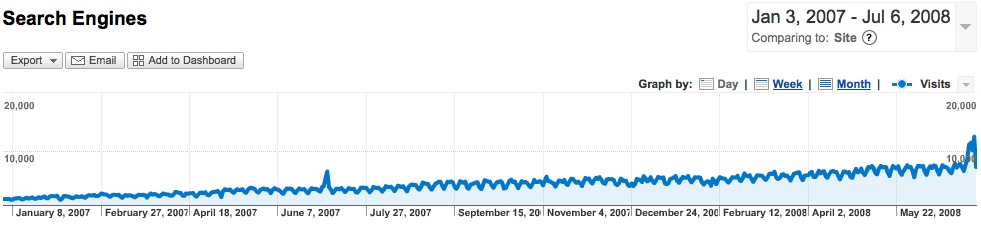
| How to Grow Search Engine Traffic to Your Blog Posted: 09 Jul 2008 09:02 AM CDT I was chatting with a blogger yesterday about search engine traffic. They asked me how much traffic I got to my blogs from Search Engines each day and when I told them that it was between 6000-8000 unique visitors a day (to Digital Photography School) their reaction was: ‘Can you tell me how to get that much traffic to my blog from Google?’ Today I emailed them this screen shot from Google Analytics of the DPS blog (click to enlarge - note, this doesn’t include DPS forum traffic).
The chart above shows 18 months of search engine traffic to DPS. I can’t go back any further than this because I wasn’t using Google Analytics before January 2007 - but the if you imagine the line goes back on the same trajectory for a further 8 or so months you’ll have a fairly accurate graph in your mind. The reason that I sent this chart was to highlight the gradual and steady growth of search engine traffic to the blog. Apart from two spikes in traffic (can anyone guess what they were for?) the traffic growth has been incredibly steady and fairly predictable. While some SEO types will promise you overnight traffic from Google if you let them build links for you - my experience of search engine traffic on quality blogs has been much more along the lines of what you see illustrated here. Don’t Get Frustrated - Look at the Big PictureIt is easy to look at statistics of a blog and grow frustrated. For example lets look at my Search Engine Traffic to the DPS blog for the month of January this year:
Doesn’t look like much improvement (if any) does there? The fact is that when I do a ‘monthly view’ of any month since I started the graph always looks much the same - small rises and falls - but none of them seem to show much growth. However when you look at them over time the trend is a gradual growth. Why does Search Engine Traffic grow so steadily over time?There are two main factors that contribute to the stead growth in search engine traffic that you see illustrated here: 1. Steady Addition of Content - every day I add a new post to DPS. This means that the archives are slowly growing over time with each post being a new potential pages for people to find when they search Google. There are currently just over 600 posts on the blog - if you were to chart their addition to the blog I suspect it’d be a very similar graph to the one you see above. 2. Gradual Growth in Incoming Links - over time DPS has gradually grown in it’s profile and popularity with other bloggers. While there are some posts that attract more incoming links than others - the growth in external links pointing at the blog has been something that has happened steadily over time. As a result the blog has growth in authority in the eyes of Google. Other factors are also no doubt at play. The age of the domain, the interlinking of posts (internal links count for link building too), improvements in SEO etc all have played a part in the growth of search engine traffic. However it is interesting to note that despite me making a variety of SEO tweaks along the way that none of them have brought a marked increase in traffic to the blog. While there’s a lot of strategies that you can employ to grow search engine traffic to your blog - the take home lesson is to keep adding quality content (the kind that people will want to share with others) to your blog. If you do this steadily over time you put yourself in a position to capitalize on that work. |



| You are subscribed to email updates from ProBlogger Blog Tips To stop receiving these emails, you may unsubscribe now. | Email Delivery powered by FeedBurner |
Inbox too full?  Subscribe to the feed version of ProBlogger Blog Tips in a feed reader. Subscribe to the feed version of ProBlogger Blog Tips in a feed reader. | |
| If you prefer to unsubscribe via postal mail, write to: ProBlogger Blog Tips, c/o FeedBurner, 20 W Kinzie, 9th Floor, Chicago IL USA 60610 | |