ProBlogger - Latest Posts |
| Andy Beal Shares His Blog’s Tipping Point Posted: 14 May 2008 06:11 AM CDT Andy Beal - author of a great book by the name of Radically Transparent - today shares his blog’s ‘tipping point’. The biggest tipping point for me was a redesign of MarketingPilgrim.com. I moved from Blogger to WordPress and also had a custom template built. Within 30 days of the redesign, I had twice as many RSS subscribers and enough new advertisers to fully cover the cost of redesigning the site. |
| Win one of 50 ProBlogger Books Posted: 13 May 2008 08:26 PM CDT Want to win a copy of the ProBlogger book? ScribeFire is giving away 50 copies to people who sign up for their newsletter. More details here. Also over at ScribeFire’s blog today is my latest guest post - How to Increase Page Views on Your Blog. |
| Leo Babauta shares his Blog’s Tipping Point Posted: 13 May 2008 02:48 PM CDT In the Skribit question widget in my sidebar the number 1 requested post is for me to ask ‘a bunch of pro bloggers what their tipping point was?’ I’ve done just that over the last few days and a few answers have trickled in so far. The first is from Leo Babauta from Zen Habits.
The tipping point came when two things converged for me, early on in the life of Zen Habits (first quarter 2007). The first thing was that I was gaining readers a bit at a time, until I had a small but extremely positive and encouraging group of readers. The second was when I realized that they were there not only to respond to my posts and be an audience, but to shape my blog and its future. By listening to my readers, and having a conversation with them, I was able to figure out what they really wanted, what kinds of posts would be most interesting and useful to them, and to give Zen Habits a character that was not just mine but theirs as well. update - question submitted by Trent. |
| Ad Design - Tactics to Increase Your AdSense Earnings Overnight Posted: 13 May 2008 09:12 AM CDT
Today I want to talk about AdSense Ad Design - another key factor in the performance of AdSense ads. In my previous posts I’ve talked about how changing the positioning and numbers of ads has seen significant changes in my own AdSense earnings at different times - ad design can have a similar impact. AdSense give quite a bit of control over how text ads can display on your site. You can change the color of a number of elements in ad units by changing the ‘color palettes’ that you choose. As you can see above in the ‘default’ color palette there is the option to change the color of ad borders, the title, background, text and URL. There are rumors floating around at the moment that we might have more control over the font of ads too in the future (I’ve been seeing a variety of fonts in my own ads lately which is a signal that Google is experimenting). Unfortunately there’s not a single color palette that works best on every blog. As with everything - testing different color schemes is the only way to work out what works best for you. There are a number of different AdSense ad design strategies that bloggers have used over the years. Lets look at three of them: 1. Contrasting AdSense AdsWhen I first started experimenting with AdSense the trend among publishers was to do everything possible to make the ads be seen. The theory is that if people see the ads they’ll be more likely to click them. The result was some of the most horrendous color combinations that you’ll ever see put together in an AdSense unit. Warning - what you see below might induce headaches…. I’m not sure why anyone would select this kind of combination but it was commonplace a few years ago. I saw a number of publishers back in that day saying that a Red/Yellow combination worked best. The Pros of this design where that they were eye catching - the Cons were that they didn’t do a lot for creating a great first impression of your site. 2. Blended AdSense AdsAs a result the trend moved from ‘clashing’ ads to what was known as a ‘blended’ approach. The keys to this approach were to set the background and borders of ad units to match the background of the site that they were going. In doing so you removed any border/boundary between the ad an your content. The Title was then made to be the same color as links on the site. Text was made to match the color of text on the site and the URL field either was made to match the title OR to be as light a color as possible (a light grey) so as to blend into the background as much as possible. The attempt was to make the ads blend into the site as much as possible and look like an integrated part into the site. So ads here at ProBlogger with a blended design might look like this: The pros of this approach was that ads didn’t clash with the site and as a result didn’t scream ‘CHEAP AND NASTY MONEY GRABBING WEBSITE’. The ads also performed better in most cases than a ‘clashing’ ad. The Cons were that sometimes the ads could blend too much into the site, particularly those sites which had a loyal readership which became blind to the ads. 3. Complementary AdSense AdsOver the last couple of years another term has crept into AdSense publisher circles to describe ads - ads that ‘complement’ a site. These ads are similar to blended ads but they don’t completely blend in. They complement the colors of the site but aim to also stand out a little by adding a different background and border color. The color you use might be unique to the ads but still ‘match’ the overall colors on the site. This type of ad is what Google recommend if you’re putting an ad in your sidebar or some slightly out of the way part of your blog as it draws the eye to it. However if you’re putting an ad in or close to content they suggest a blended ad. 4. Designer AdSense AdsMost publishers still use a blended or complementary approach (I do) but over the last few years a number of AdSense publishers have played with incorporating different design elements around their ads to integrate them even more fully into the site. There was a period where publishers got away with aligning images directly beside, above or below ads - AdSense cracked down on this and now don’t allow it at all - however there are ways to incorporate the ads into the design of your site. I first wrote about this in a post called Designer AdSense Ads where I highlighted these two ads from Karen Cheng’s blog: You can see the ads themselves are placed inside frames that integrate the ads into the design of the site. Interestingly Karen no longer uses these ads on her blog. I’ve seen a number of publishers attempt to do this with mixed success. It’s something to experiment with. So Which AdSense Ad Design is Best?The choice of which AdSense ad design to choose for your blog is a decision that you need to weigh up on a number of fronts including:
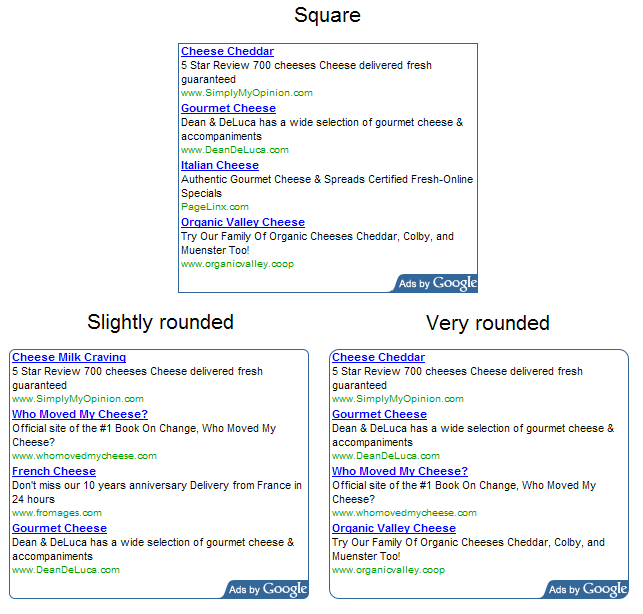
When it comes down to purely financial considerations - the fact is that sometimes blending works best and on other occasions it can be better to go with a more contrasting approach. Check out the official advice from AdSense: “The color strategy you should use on your site varies depending on the ad placement and the color of the background where the ads are placed. Review the table below for a quick reference about which strategies we suggest will work well on your site.” You can see the overall design of your site comes into question quite a bit in the eyes of AdSense. Other Design ChoicesThere are a few other choices that publishers have when it comes to the way that their ads look. Curved Corners Your choice with the corners of your ads only comes into play if you go for a complementary or contrasting approach (ie blended ads effectively don’t have borders that can be seen). The choice will will depend upon the design of your blog. If you have curves on other design elements this will help to integrate the ads better. Rotate ads You can manually do this on a regular basis or use the built in mechanism that AdSense offers for you to choose up to 4 different color palettes for your ads to automatically rotate through. Test Test TestThe key to finding the right AdSense Ad Design for your blog is to test different options and see what works best for you. One way to do this is to try Split Testing (sometimes called A/B testing). I’ll write up how to do this tomorrow - stay tuned! |
 Over the last week I’ve been covering a few


| You are subscribed to email updates from ProBlogger Blog Tips To stop receiving these emails, you may unsubscribe now. | Email Delivery powered by FeedBurner |
Inbox too full?  Subscribe to the feed version of ProBlogger Blog Tips in a feed reader. Subscribe to the feed version of ProBlogger Blog Tips in a feed reader. | |
| If you prefer to unsubscribe via postal mail, write to: ProBlogger Blog Tips, c/o FeedBurner, 20 W Kinzie, 9th Floor, Chicago IL USA 60610 | |